Traveling to Tam Coc - Bich Dong, Ninh Binh
Where is Tam Coc - Bich Dong?
Tam Coc - Bich Dong is a large landscaped area, featuring limestone caves, beautiful village scenery and Bich Dong ancient pagoda. Tam Coc - Bich Dong tourist area is located in Hoa Lu district, Ninh Binh province, about 100 km away from Hanoi.
Tam Coc - Bich Dong Ninh Binh is part of the Trang An Scenic Landscape Complex - a UNESCO-recognized dual world heritage for cultural and natural values.

‘
‘
What is the most beautiful season in Tam Coc - Bich Dong
When should you go to Tam Coc - Bich Dong tourist area? Tam Coc - Bich Dong has two basic seasons: rainy season and dry season, the rainy season starts from May and lasts until October, while the dry season lasts from November to April. The best time to visit Tam Coc - Bich Dong is from May to mid-June because this is the golden rice season in Tam Coc, with the rice fields gradually turning from green to bright yellow.
If you want to attend the festivals of Ninh Binh such as Trang An festival, the spring opening festival of Bai Dinh pagoda - the temple associated with many world records, then you should go in the 1st to 4th lunar month.
'
'
How to get to Tam Coc - Bich Dong
By Road
Public transport
Bus routes from Hanoi to Ninh Binh start at Giap Bat bus station and end at Ninh Binh central bus station. In addition, if your location is convenient to catch the cars to Thanh Hoa, Vinh, Ha Tinh provinces... you can also take these cars to go through Ninh Binh, they are numerous and quite continuously.
Private vehicles
- If driving a car, from Hanoi you can follow the Phap Van - Cau Gie - Ninh Binh highway, with a distance of about 90km, it only takes about 1 hour - 1 hour 45 minutes to reach the Ninh Binh city center.
- If riding motorbikes, from Hanoi you follow the old National Highway 1A through Ha Nam and then go in the direction of Ninh Binh - Thanh Hoa. Pay attention to the signposts to avoid going to the wrong direction in the direction of Nam Dinh - Thai Binh.
'
By Rail
Ninh Binh has Tam Diep - Ninh Binh urban axis located on the North-South railway line. In this province, there are Ninh Binh stations, Cau Yen stations, Ghenh stations and Dong Giao stations. Therefore, whether you are in the South or in the North, you can easily come to Ninh Binh by train.
From Hanoi, there are SE1 trains (19:30) to Ninh Binh at 21:46, SE3 train (22:00) to Ninh Binh at 0:10, SE5 train (9:00) to Ninh Binh at 11:21, SE7 train (6:00) to Ninh Binh at 8:22 and SE19 train (20:05) arrives in Ninh Binh at about 23h.
If departing from Saigon, almost trains arrive in Ninh Binh at a rather late hour, the only suitable train that you should take is SE8, which departs from Saigon station at 6:00 and arrives in Ninh Binh at 13:15 the day after.
'
Going from Ninh Binh city to Tam Coc - Bich Dong
If you do not have personal transportation, you can rent a motorbike at any motel, hotel, homestay in Ninh Binh, or simply take a taxi. With a group of 4 people, the price of a taxi from Ninh Binh City to Tam Coc is only a few tens of thousand. However, the advice for you is to rent a motorbike in Ninh Binh to explore many beautiful places. In addition, tourist attractions in Ninh Binh are not too far from each other, going by motorbike is the best option.
‘
‘
Ticket price for visiting Tam Coc - Bich Dong
Tam Coc - Bich Dong Pagoda route
– Entrance tickets for scenic spots
Adults: 120,000 VND/person/time
Children (under 1.4m tall): 60,000 VND/person/time
– Ferry ticket: 150,000 VND/boat trip
Domestic guests: 4 people/boat/trip (5th person surcharge: adult: 40,000 VND; child: 20,000 VND)
International guests: 2 people/boat/trip (3rd person surcharge: adult: 75,000 VND; child: 35,000 VND)
'
Thach Bich - Thung Nang route
– Entrance ticket
Adults: 20,000 VND/person
Children from 6-15 years old: 10,000 VND/person
Elderly people (from 60 years old and above): 10,000 VND/person
– Boat ticket:
Adults: 100,000 VND/trip
Children from 6-15 years old: 50,000 VND/trip
Elderly people (from 60 years old and above): 50,000 VND/trip
Domestic passengers: 4 people/boat/trip
International guests: 2 people/boat/trip
‘
‘
Beautiful places to travel in Tam Coc - Bich Dong
'
1/ Tam Coc - Bich Dong Pagoda route
Tam Coc
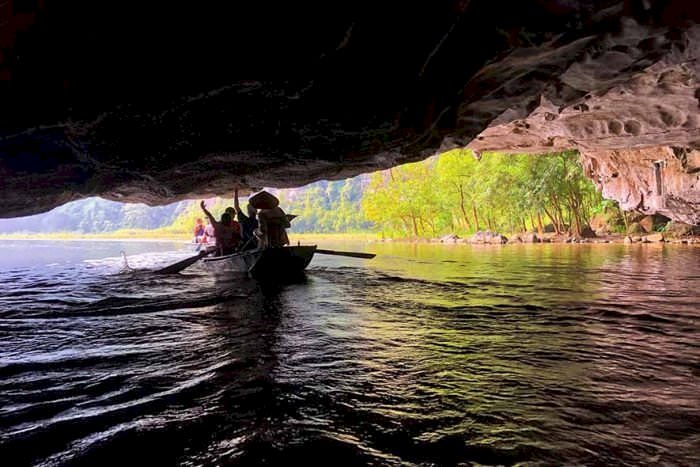
Tam Coc, which means "three caves", includes Ca cave, Hai cave and Ba cave. All three caves are formed by the Ngo Dong River crashing through the mountain. Tam Coc is the first cruise line operated in Tam Coc - Bich Dong tourist area. Tourists when visiting Tam Coc only have a single waterway, it takes about 2 hours to get in and out. You go to Cac communal house in Van Lam village, go to Ngo Dong river wharf - the waterway leading to Tam Coc.
Ca cave is 127m long, flows through a large mountain, the mouth of the cave is over 20m wide. In the cave, the climate is quite cool and there are many stalactites hanging down in various shapes.
Hai cave, nearly 1 km away from Ca cave, is 60m long, the ceiling of the cave has many strange hanging stalactites
Ba cave, near Hai cave, is 50m long, the ceiling of the cave is like a stone arch, lower than the other two caves.
Want to visit Tam Coc, visitors get off the boat from the central wharf. Boats take tourists on the Ngo Dong river winding through the cliffs, water caves, rice fields. Travel time and return is about 2 hours. The scenery of Tam Coc, especially the two sides of the Ngo Dong River, can change according to the rice season (green rice, golden rice or silver color of the water in the field).

‘
Thai Vi Temple
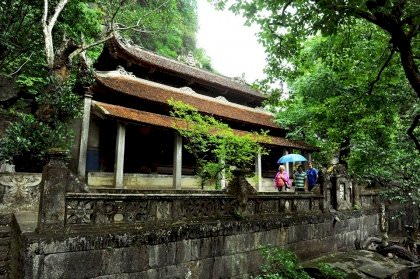
Thai Vi Temple is the place to worship Kings Tran Thai Tong, Tran Thanh Tong, Generals Tran Hung Dao, Tran Quang Khai and Queen Tran Thi Dung. In the past, the Tam Coc mountain area was the place where the Tran Dynasty came to set up the Vu Lam palace in the resistance war against the Nguyen Mong. There are two ways to get to Thai Vi temple. The first way is on the boating way to Tam Coc, at the entrance to the shore, stop at the beginning of the small path to walk to the temple. The second way is from Van Lam wharf, turn right, follow the road that parallels the Ngo Dong river to enter the temple.
‘
Thien Huong Cave
Thien Huong Cave is located on the road from Ngo Dong River to Thai Vi Temple, is a dry and bright cave located halfway up the mountain with an altitude of about 15m above the ground. The cave is about 60m high, 40m deep, and 20m wide. The top of the cave is hollow, so the cave is also called Troi Cave. Nestled in the cave is a shrine dedicated to Tran Thi Dung, wife of King Ly Hue Tong, the person who has passed on to the people of Ninh Hai commune the craft of embroidery.
‘
Xuyen Thuy Cave
Xuyen Thuy Cave is a dark and flooded cave located along the length of Bich Dong massif. Xuyen Thuy is like a 350m-long semicircular stone pipe winding from the east to the west. The average width of Xuyen Thuy cave is 6m, the widest place is 15m. The ceiling and walls of the cave are usually flat, creating a large stone slab like a semicircle dome with various shapes.
The entrance to Xuyen Thuy Cave is at the back of the mountain, opposite the road to Bich Dong Pagoda. At the end of the journey through the water cave, visitors can climb the mountain to reach the cave and Bich Dong pagoda.

‘
Bich Dong Pagoda
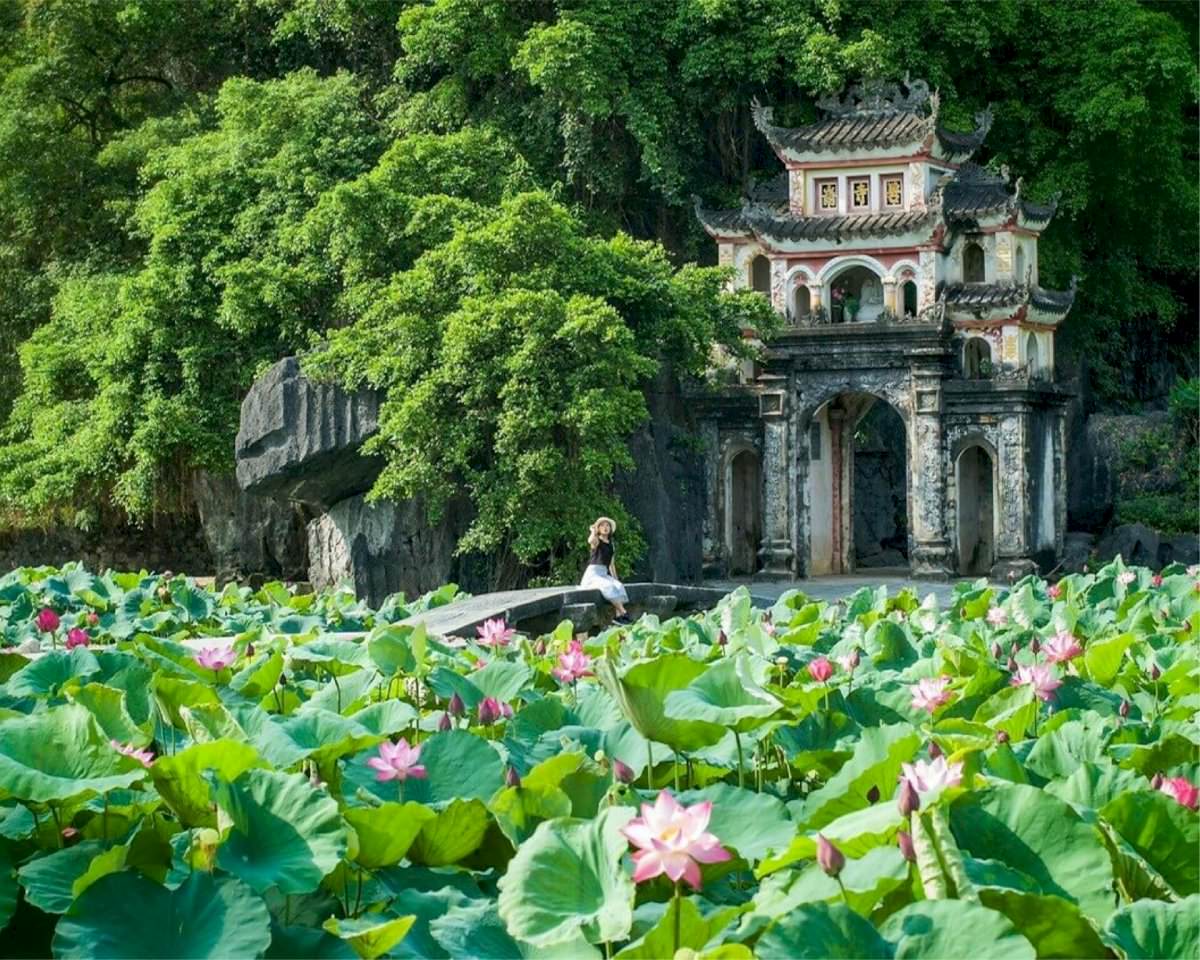
Bich Dong Pagoda is located about 3 km away from Tam Coc. The pagoda was built in 1428 on the Truong Yen limestone mountain range. Bich Dong means Green Cave. Bich Dong has been dubbed "Nam Thien De Nhi Dong" (the second most beautiful cave in the South Heaven).
On both sides of the small path leading to the temple's gate are thousands of lotus flowers blooming on the river. Bich Dong Pagoda consists of 3 separate pagodas: Ha Pagoda, Trung Pagoda and Thuong Pagoda.
‘
Ha Pagoda – Bich Dong
Ha Pagoda has a Buddha altar and a place to remember the masters who built the pagoda.
Ha Pagoda has 5 compartments built on a high foundation at the foot of the mountain, the pagoda architecture is in the style of Dinh. Trusses, crossbars and vertical beams are also made of ironwood. The roof of the pagoda is two curved roofs, including 8 roofs. The stone pillars in the lower pagoda are all made of one-piece, unassembled stone, more than 4m high, making such stone pillars is a feat.
At Ha Pagoda, a great Chinese character in the middle has the words "Ancient Tranquility" - to show that the main heart of the pagoda is purity from the past to the present. At the top is Tam The board.
‘
Trung Pagoda – Bich Dong
From Ha pagoda, going up about 120 steps to the middle of Ngu Nhac mountain range is Trung pagoda. Right in front are two words Bich Dong carved into the cliff. This is a very unique pagoda: half attached to the cave, half is open-air, has 3 rooms to worship Buddha.
In front of the door, there is an ancient delicate-carved bronze bell. Looking outside is the Giai Oan bridge. Most of the visitors here often "ring" the bell 3 times as if to "clear the blame" for their souls being at peace.
‘
Dark Cave – Bich Dong Pagoda
From Trung Pagoda going up about 6m is to Dark Cave. This is the profound and quiet main cave. The way up to Dark Cave is almost vertical, go under the Giai Oan bridge because the cave gate looks like a rainbow shape. Dark Cave has a long, wide space and electric lighting. All like a petrified fairy world of creation.
Under the floor of this small cave, there are stalactites like turtles and especially two strange rocks. Knocking on rocks makes strange noises, one makes the bass sound, the other one makes the high sound. Dark Cave is also a Buddhist natural temple.
‘
Thuong Temple – Bich Dong
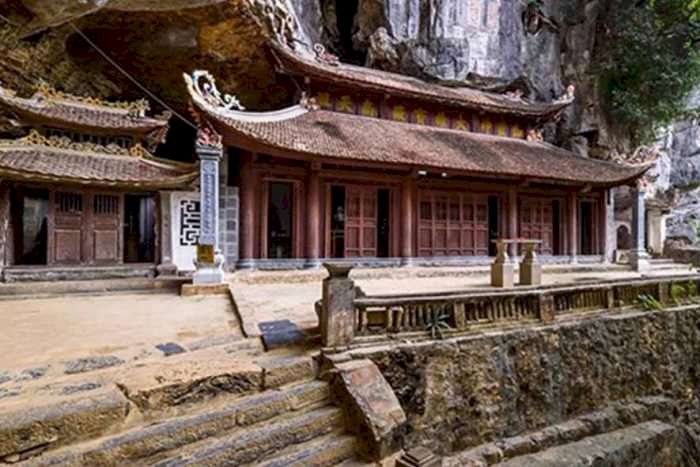
Thuong Pagoda is also known as the Eastern Pagoda, the pagoda worships Quan Am Bodhisattva. This is the temple located at the highest position, near the top of Bich Dong mountain. From Thuong Pagoda looking out into the distance, there are 5 independent mountains adoring Bich Dong mountain, which looks like 5 lotus petals, called Ngu Nhac Son, including Tam Sang mountain, Gia Dinh mountain, Con Lon mountain, Dau Cau mountain and Dau Cau mountain. Hang Based Mountain.
Standing on the Thuong Pagoda, one can have a panoramic view of the whole beautiful scene of Bich Dong Pagoda, which is not only beautiful in terms of charming scenery, cultural art - architecture, but also has the meaning of a beautiful historical site of Ninh Binh province.
‘
Tien Cave
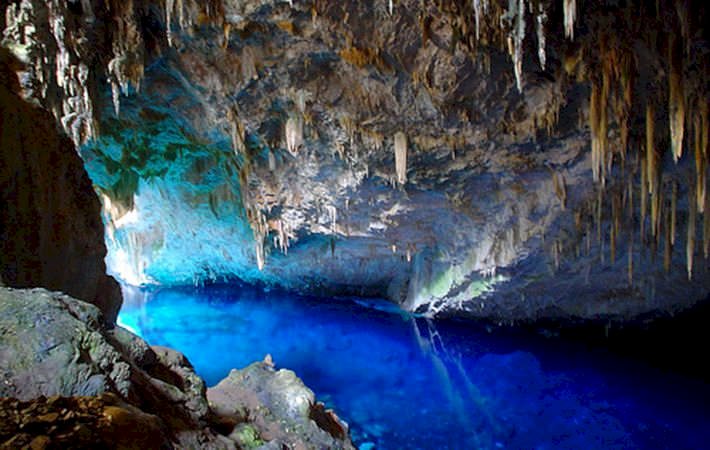
Tien cave is a beautiful dry cave of Tam Coc - Bich Dong tourist area. The cave is located nearly 1 km from Bich Dong Pagoda. The dynamic range includes three large, wide and high caves. The ceiling of the cave has many stone veins, stalactites drooping with colorful sparkles, looking like big tree roots. There are many bats and birds on the ceiling. From the outside, the cave looks like a magnificent castle. The changes of nature create interesting shapes of stalactites in the cave with the shape of money tree, rice tree, fairy, elephant, lion, tiger, iguana, dragon, eagles, and colorful clouds. Stapping the stone blocks in the cave will create many strange sounds.
‘
Linh Coc Pagoda
Linh Coc pagoda is located in Moc pagoda mountain. The pagoda faces west, in front is a water field. According to the epitaph placed in the temple, Linh Coc dates from the reign of King Tran Thanh Tong. The temple yard is large and is at the foot of the mountain; on both sides of the yard, there is a 3-compartment ancestral church facing the northwest, placing statues to worship the saint's A Nam Da and the west ancestor who is Indian with a high nose, curly hair, beard. Mother Goddess temple backs to the mountainside, in the southwest direction, built in the style of "Tam" word. The Queen's palace is a pavilion to worship the Holy Mother of God, including Mother Thuong Ngan, Mother Thoai, and Mother Lieu Hanh.
'
Ancient Viet Village - Co Vien Lau
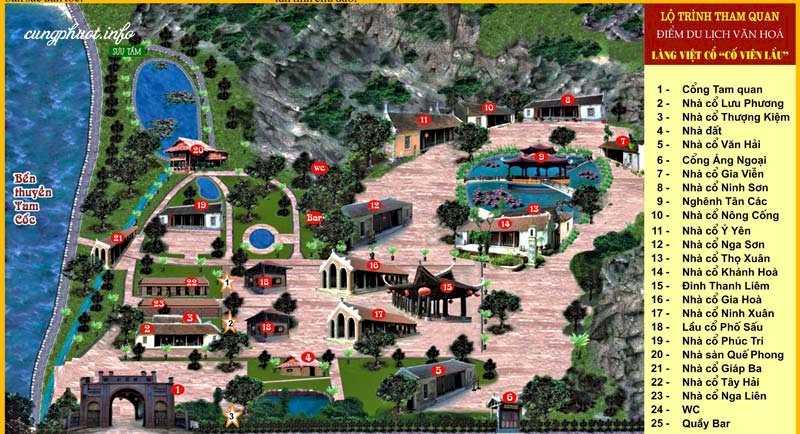
Co Vien Lau is one of the tourist attractions located in the buffer zone of Trang An World Heritage Complex, Ninh Binh. Co Vien Lau is an old house complex consisting of many old houses collected mainly in Ninh Binh and the Northern Delta region. In 2008, Co Vien Lau ancient house was added by Ninh Binh Culture and Tourism industry to Tam Coc - Bich Dong tourist area. Co Vien Lau is located right next to Tam Coc boat station and on the way to Thai Vi temple.
Co Vien Lau has an area of about 20,000 m², displaying 22 old houses in many villages in the Northern Delta. Inside the houses, there are many tools displayed such as long chair, mahogany, tea cabinet, ... Ancient houses in Co Vien Lau were mainly built from the Nguyen Dynasty back here, but also show the unique and typical culture in traditional Vietnamese architecture.
‘
2/ Thach Bich - Thung Nang route
From Dinh Cac wharf (Tam Coc), go about more than 500m by road to Thach Bich wharf to go to Thung Nang. Sitting on a boat, crossing a waterway with two sides of yellow rice fields, rolling mountains, passing Voi temple is coming to Thung Nang.
Thung Nang is a magnificent landscape, with a cloudy sky and mountains surrounding it. The journey of sitting on a sightseeing boat lasts about 3 km on the waterway, you will come to many legends such as Ba Doi mountain, Coc mountain, Mang mountain, Vang mountain...
Passing Thung Nang cave about 100m to reach Thung Nang temple. The temple was built in a quiet space, the back of the temple leaning against the sacred mountain where worship the Princess of the Forest.

After visiting Thung Nang, on the way back to Cay Gao wharf, you will come to Voi temple. Voi Temple was built of stone hundreds of years ago, with elaborately carved stone altars. Voi Temple dates to the Le Dynasty to worship Mr. Ly Dong Hai, a mandarin in the mountains.
‘
'
Source: Collected