The Imperial Citadel of Thang Long – the historic site of thousand-year capital Hanoi
Imperial Citadel of Thang Long is a complex of relics associated with the history of Thang Long Citadel, Hanoi. This massive architectural work was built by the kings in many historical periods and has become the most important relic in the system of Vietnamese monuments. On August 1, 2010, Thang Long Imperial Citadel was recognized by UNESCO as a world cultural heritage.
'
1. Introduction of The Imperial Citadel of Thang Long
The World Heritage Site in The Imperial Citadel of Thang Long comprises two sections: the archaeological site at 18 Hoang Dieu Street and the central axis of the Nguyen Dynasty’s Citadel of Hanoi, which together create an integrated heritage complex. Standing monuments in the Nguyen Dynasty’s Ancient Citadel include the Flag Tower (Ky Dai), the South Gate (Doan Mon), the Kinh Thien Palace Foundation, the Princess’s Pagoda (Hau Lau), and the North Gate (Bac Mon).
This was the most important sector of Thang Long Citadel, the capital of Dai Viet under the Ly, Tran, and Le dynasties from the 11th to the 18th centuries. It was also the core of the earlier Dai La Citadel, dating from the period when the region was ruled directly by China (7th to 9th centuries) and the headquarters of the North Vietnamese government and army during the Resistance War against the Americans (also known as the Vietnam War) between 1954 and 1975.
Situated at the heart of Hanoi, the Central Sector of the Imperial Citadel of Thang Long is an outstanding place of interest not only for the capital city but also for the country as a whole. Its Outstanding Universal Values are reflected in its historical longevity, its continuous role as a seat of power, and its multiple cultural layers.

-
2. How to go to Imperial Citadel of Thang Long
You go to 19C Hoang Dieu which is the main gate for visitors. From the center of Hanoi, you can easily go to the Imperial Citadel by means of vehicles such as motorbikes, beautiful cars, cars, buses...
If you take the bus, choosing route 22, this bus will stop at the stop in front of the gate of the Imperial Citadel.
'
3. Ticket price and Visiting time
Ticket price:
- Adults: VND 30,000/person/tour
- Vietnamese students (15 years old or above) and old people (60 or above): VND 15,000
(Note: Student cards and identity cards must be presented upon purchase of tickets.) - Children under the age of 15 and people who were of meritorious service to the country during the war are exempt from tickets.
Visiting time:
- Visiting time: All days except Monday.
- Opening time: every day from 8:00 a.m to 5:00 p.m.
'
4. Places to visit in the Imperial Citadel of Thang Long
'
18 Hoang Dieu archaeological monuments
This archaeological site is situated at 18 Hoang Dieu Street, Ba Dinh District, and is analyzed and divided into 4 zones, named A, B, C, and D by Archaeological Institute.
In this area, archeologists have found a lot of different types of architectural monuments and relics with mixed date, overlaying on top of each other over the past 1300 years, starting from Dai La Dynasty (7th – 9th centuries), Dinh – Early Le Dynasties (10th century), Ly Dynasty (1009-1225) and Tran Dynasty (1226 – 1400), Ho Dynasty (1400 – 1407), Le (1428 – 1527), Mac Dynasty (1527 – 1592 ), Le Trung Hung (1592 – 1789) and Nguyen (1802 – 1945).
A large-scale archaeological excavations in the centre of Thang Long Royal Citadel revealed a wealth of monuments and relics which showed us the uninterupted development of the history under dynasties in Thang Long – Hanoi. Rare countries in the world have the capital that still preserves relics in the earth of long-term cultural and historical layers overlaying quite continuously like in Thang Long – Hanoi. This is a salient point, contributing to tremendous value and uniqueness of the relics.


'
Doan Mon (Main Gate)
Doan Mon is one of the main entrances to the Forbidden City. Basing on construction materials and remaining architectural style of the relics, it can be affirmed that current Doan Mon was built under Le Dynasty and restored in Nguyen Dynastry.
The main architectural part followed watch tower gazebo style with three rolling arches. Materials are mostly wooden-hammer bricks, a popular type of bricks under Le Dynasty and rock which were used for building the arch. Hanoi Flag Tower was built in 1812 under King Gia Long’s reign, Nguyen Dynasty in the sounthern part of Thang Long Imperial Citadel in where Tam Mon Palace under Le Dynasty had been built. Archaeologists found traces of a path paved with “lemon flower” bricks under Tran Dynasty. According to north-south direction, the road is expected to last for more and it’s probably the path from Doan Mon Gate to Thien An Palace under Tran Dynasty. It is noteworthy that in some paths under Tran Dynasty, Ly Dynasty bricks were still used.

'
Hanoi Flag Tower
Hanoi Flag Tower was built in 1812 under King Gia Long’s reign. The Flag Tower includes three-tier basement and a column three storeys and a tower. The truncated square pyramid-shaped storeys are faced with bricks.
The first tier has the length of each side of 42.5m, the height of 3.1m and two brick staircases. There is a spiral staircase which consists of 54 steps leading from the first to the third tier. It is lightened and ventilated by 39 flower-shaped and 6 fan-shaped windows which scatter along the fringes. Each tier has 4 doors facing four directions.

'
Kinh Thien Palace
Kinh Thien Palace is the central monument and the core in the overall historic sites within Hanoi Ancient Citadel. Doan Mon (the Main Gate) and the Flag Tower of Hanoi are situated in the front of Kinh Thien Palace, Hau Lau (Princess’ Palace) and Cua Bac (Northern Gate) at the back, walls and smaller gates in the east and west.
Traces of KinhThienPalace are now only the old foundation. In the south, the palace foundation still had handrail corridor of higher than 100 cm. In the front, the south of Kinh Thien Palace was the palace threshold built with large slates with 10 steps; the 4 stone dragons divided the steps into 3 alleys, forming the Royal Threshold.
Kinh Thien Palace stone dragons were a masterpiece, representing the sculpture under early Le Dynasty. Carved with green rock, the dragons had raised big heads, round convex eyes, long horns, and mane gliding back. The dragon body formed many small curves, smaller toward the palace foundation; on the back, there was a long fin heaving like clouds or fire. The two sides of the threshold had two stone dragons dating King Le Trung Hung’s time.
The foundation and threshold are meager relics of palace architecture under the Le Dynasty that remains to this day, partly reflecting the grand scale of Kinh Thien Palace in the past.

'
Hau Lau (Princess Palace)
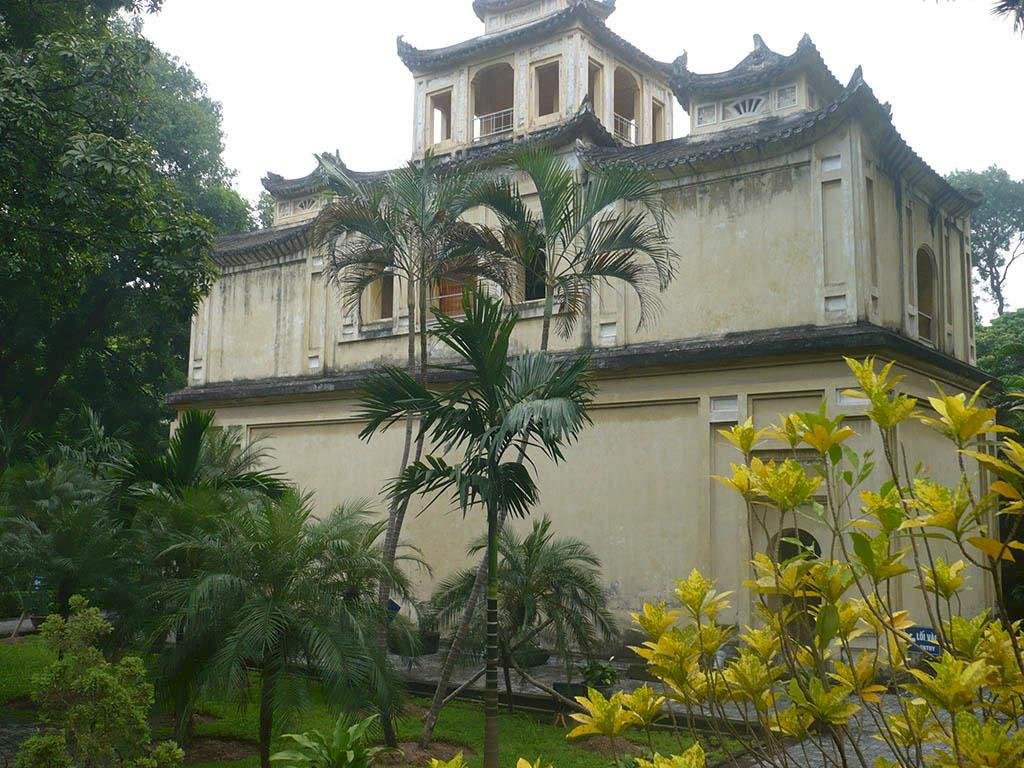
Hau Lau is about 2.392m2, once known as Tinh Bac Lau (Palace that keeps the North peace), was built after the Later Le dynasty, the whereabouts for living and daily activities of the queen and the princess. Under Nguyen Dynasty, Hau Lau was used as the residence of imperial concubines and followers who accompanied the King to Bac Ha.
'
Northern Gate
Cua Bac (Northern Gate of Thang Long Imperial Citadel) is situated in Phan Dinh Phung Street which was built in 1805 and is the only remaining gate to Hanoi Citadel under Nguyen Dynasty. Traces of cannons fired from French battleships in 1882 could be seen on the gate.
Currently, the watch tower gazebo is being restored partly for worshiping two province chiefs of Hanoi Citadel i.e. Nguyen Tri Phuong and Hoang Dieu who sacrified for not being able to defend the citadel under the assault of French army.

'
House D67
Historical and revolutionary relics – House D67 had associated with the operation of the Politburo, the Central Military Commission of the Communist Party of Viet Nam, Minister of Defense and Chief of the General Staff of People’s Army of Vietnam since September 1968. In seven years, the house provided a safe place for the commanders in chief to work, plan policies and direct the successful implementation of the final phase of the resistance war against the US.

'
5.Visiting regulations
Visitors to the Central Sector of the Imperial Citadel of Thang Long – Hanoi, are requested to observe the following regulations:
- Follow the guide map of the site.
- Do not carry weapons, explosives, flammable substances, toxic chemicals and stinking objects into the site.
- Dress neatly and politely. Use of vulgar words and acts of vandalism such as drawing indiscriminately on the walls and trees or causing disorder in the site are strictly prohibited. The vehicles such as cars, motorbikes and bikes have to be parked in the designated place, which is at 19C Hoang Dieu Street.
- Protect the site and the artifacts and keep the environment clean. Do not climb on trees, break branches, pick fruits and walk on the grass.
- Contact the Guide and Interpretation Department for tour guide service. Organizations or individuals who wish to make visual recordings or films within the site must first get the permission from the management board of the site.
- The use of ultralight flight instrument or flycam is not allowed in the heritage site.