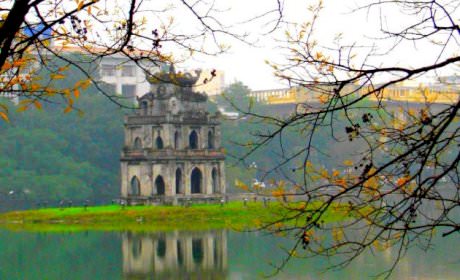
Tran Quoc pagoda - the holiest sanctuary pagoda in Hanoi
Tran Quoc Pagoda is more than 1500 years old, which means the place holds such an important role in the development of Vietnam in general and Hanoi in particular. That is the main reason why the temple attracts thousands of visitors from all over the world every year. In particular, in 2016, Tran Quoc Pagoda was included in the list of 16 most beautiful temples in the world voted by the British Daily Mail.
Location: Thanh Nien Road, Yen Phu ward, Tay Ho District, Hanoi
Opening Hours: from 8 am to 6 pm every day
Entrance fee: free
'
History Of Tran Quoc Pagoda
It was constructed in541 and completed in 545 under the reign of King Ly Nam De. At that time, it was called as Khai Quoc Pagoda (Khai Quoc means National Founder). It was first built on the bank of the Red River. When the river bank crumbled after more than 150 years, it was moved to the Kim Ngu (Golden Fish) Islet in the early 17th century, under the reign of King Le Kinh Tong. Since then, its name changed to Tran Quoc (National Defense).
With a history of over a thousand years, it used to be the capital of Buddhism during the Tran dynasty and now still considered as a symbol of Hanoi capital.

'
Architecture and Structure
Tran Quoc Pagoda has undergone many restorations, the appearance has changed somewhat, the size and architecture of the temple is now the result of a major restoration in 1815. The total area of the temple is more than 3000m2.
Famous for sacred sanctuary and stunning scenery, Tran Quoc Pagoda used to be a favorite place for sightseeing of many kings of Vietnam in special festivals such as Tet holiday and full moon days. More than 1000 years have passed, the pagoda still preserves its fame and unique characteristics in its architecture in spite of urbanization.

Tran Quoc has a special architecture which resembles that of ancient temples in Hanoi. Going through the gate, you need to follow the way which is paved with red brick to see the interior space. It bears the bold Buddist architectural image with many layers of buildings. You can see it clearly through the three main houses of the pagoda.
- Tien Duong (the Front House) is located in front of the bell tower and faces the west. In front of the Front House, there is an incense burner in the yard so the Buddhists and tourists can thurify.

'
- Nha To (the Ancestor House) is on the right of Tien Duong, worshipping the previous generation of monks.

'
- Nha Bia (the Stele House) is on the left of Tien Duong, holding 14 important steles engraved from 1813 to 1815. It shows the renovating process of the pagoda after a long time in ruin.

The three main houses are connected and make the pagoda look like a blooming lotus. It can be said that Tran Quoc pagoda is a harmonious combination of the serene ambiance of green garden, far-flung lake, and ancient and imposing architecture. That’s why it was recognized as a national monument in cultural and historical values by the Ministry of Culture and Information in 1962.

'
Highlights of Tran Quoc Pagoda
Due to its beautiful and peaceful scenery, Tran Quoc Pagoda was mentioned in a lot of poems and parallel sentences of Vietnamese kings and mandarins, especially under Nguyen Dynasty. Until now, there are many poems preserved in the pagoda. You will have a chance to get to know Vietnamese literature style in the past and the country’s history also.
It would be a miss if not mention “Bao Thap Luc Do Dai Sen”. It is an eleven-story which is 15 meters high. Being built in 1998, it has six arched doorways and a statue on each floor. The statues resemble Buddha Amitabha and are made of precious stones. There is a nine-story lotus on the top of the tower and it is called the “Cuu Pham Lien Hoa”.

This tower is on the opposite side of the sacred Bodhi tree through the three main houses. The tree was donated to the temple in 1959 by the Indian President Rajendra Prasad on his trip to Hanoi. The sacred Bodhi Tree has heart-shaped leaves, and many people believe that it is a branch of the sacred bodhi tree where the Buddha enlightened more than 2500 years ago.

Besides, it can be said that Tran Quoc is a small museum storing priceless antiques because a fairly complete system of statues is still preserved here. Most of them are hundreds of years old such as some worshipping statues in the front house. Notably, there are statues of Three Sages and ancestor monks of the pagoda. The most outstanding one is the statue of Buddha entering Nirvana (the folk often calls him the Reclining Buddha or “Thich ca thap niet ban”). This statue is evaluated as the most beautiful statue in Vietnam.

'
How to Get to Tran Quoc Pagoda
The pagoda is just 5 kilometers from the city center, so you can reach there by different means of transportation.
- By bus: you can catch bus No. 50 that drops you right in front of the pagoda. If it’s not convenient to catch this bus. Please get on bus No. 31, 41, 55A, 55B or 58 to stop at An Duong bus stop, then take a walk around 5 minutes to get there.
- By personal vehicle: you can go by car, bicycle, scooter…and park your vehicles at the parking area in front of the pagoda. Note to check the price first to ensure the money you need to pay.
'
Tips on Visiting Tran Quoc Pagoda
-
The pagoda is always crowded, especially on the 1st and 15th day of the month in the Lunar Calendar, on which Buddhist monks and tourists visit the site for thurify and sightseeing. If you want to explore the Vietnamese’ religious culture, these two days are always a great time. But if you don’t like huge crowds, it is a good idea to avoid these days.
-
Because the pagoda is a holy sanctuary, visitors must wear an appropriate outfit, clothes need to be not too short and do not wear skin-showing clothes.
-
Remember to show your respect to the gods and the pagodas.
'
Source: Collected